
Business Strategy - Digital Strategy - Data Strategy
From a business governance perspective, these three strategies form a hierarchical and interconnected framework, where each level builds upon and enables the others. Here's how they relate:
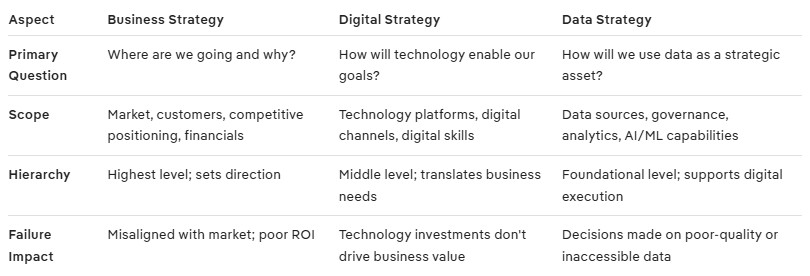
Business Strategy is the Foundation, i.e. the overarching blueprint that defines your organization's direction, competitive positioning and value creation. It answers fundamental questions, such as: What markets will we serve? How will we differentiate ourselves? What are our growth targets? It sits at the apex and drives all other strategic decisions.
Digital Strategy is the Enabler. It translates business objectives into digital capabilities and operating models. It determines how you'll use technology (cloud infrastructure, digital channels, automation, platforms) to achieve business goals. Digital strategy is subordinate to business strategy; it exists to support business objectives.
Data Strategy is the Intelligence Layer and most granular level. It focuses on how you'll collect, manage, govern, and leverage data to support both your Business Strategy and your Digital Strategy. It encompasses data architecture, quality frameworks, analytics capabilities, and data governance policies. Data strategy exists within the digital ecosystem but ultimately serves business outcomes.
How they work together
The Governance Perspective
The following principles apply from a governance perspective. You need to consider and apply them in order for the strategy framework to function.
Alignment and Cascade: Business strategy must cascade into digital and data strategies. If there is misalignment—for instance, a data strategy that doesn't support digital initiatives, or digital investments that don't serve business goals—you'll see wasted resources and missed opportunities.
Dependency and Enablement: Digital and data strategies are dependent on business strategy for direction, but enable it through execution. They're not independent; they are conditional.
Governance Integration: Strong governance means having clear ownership at each level. In a very large, global organization a Chief Strategy Officer typically owns business strategy, a Chief Digital Officer oversees digital strategy, and a Chief Data Officer manages data strategy; and they must be aligned through governance structures like strategy committees. In a smaller organization, they can be assigned among CEO, CDO, CFO, CIO with the obvious constraints.
Risk and Compliance: Data strategy requires robust governance around data privacy, security, and compliance. This feeds back into digital strategy (architecture decisions) and supports business strategy (enabling sustainable competitive advantages while avoiding regulatory risks).
Measurement and Accountability: Each strategy should have metrics connecting to the level above it. Data quality metrics should support digital KPI's, which in turn should support business outcomes (e.g. revenue growth, market share).
Caveats and Conclusion
When these strategies operate in silos or misaligned, you have digital transformations that don't drive revenue or efficiency gains, investments in data that is decision-irrelevant, business strategies that ignore technological constraints or even regulatory constraints, duplication of efforts and diluted ownership.
Successful organizations treat these three as an integrated system where
business strategy provides the "why," digital strategy provides the
"how," and data strategy provides the means.